


Recent posts
Oct 03, 2026
Oct 03, 2026
Coral, Amber and Silver: Reading...
Oct 03, 2026
The Silver of Tiznit: Where...
- Oct 03, 2026
- By RAIS
- 0 comments
The Silver of Tiznit: Where Berber Jewelry Learned to Speak
Some objects are made to be admired. Others are made to be carried through a life. The silver of Tiznit belongs to the second kind.
A town built around a craft
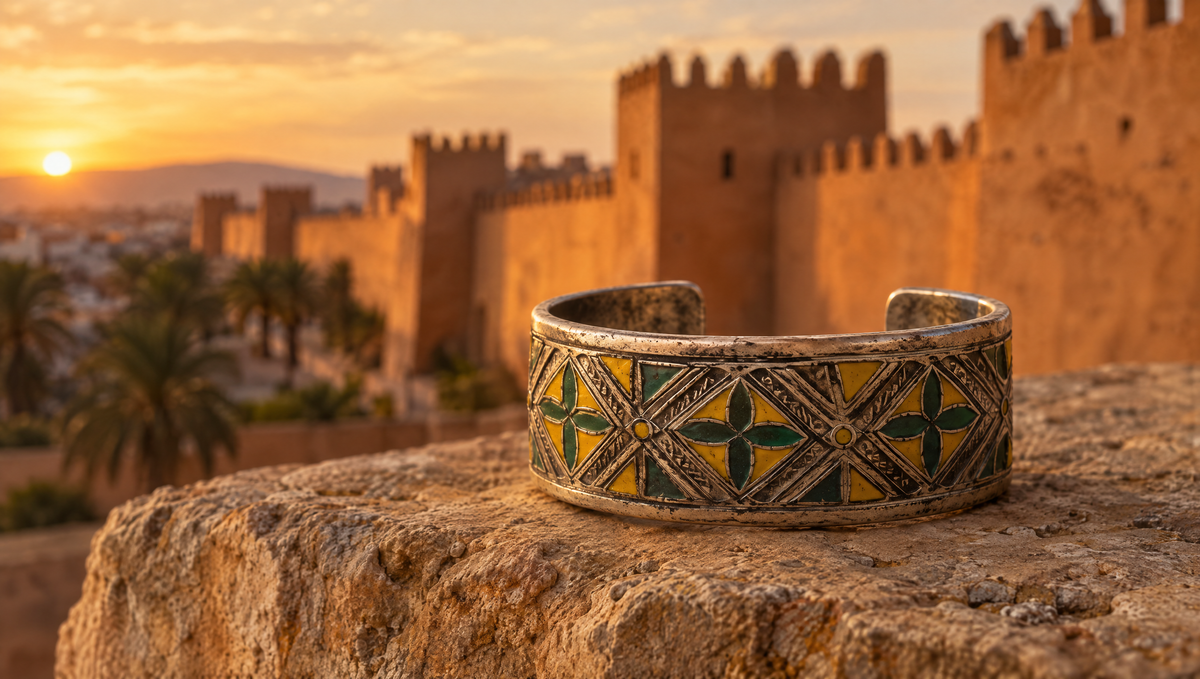
Tiznit sits in the Souss region of southern Morocco, between the Atlantic coast and the dry slopes of the Anti-Atlas. Its long ochre ramparts date from the late nineteenth century, when Sultan Moulay Hassan I fortified the town. But the craft that made Tiznit famous is older than its walls.
For generations, the town's workshops supplied the villages of the surrounding mountains and plains with the jewelry that marked every stage of a woman's life: the pieces she received at her marriage, the ornaments she wore at festivals, the amulets meant to keep harm away from her and her children. Today, Tiznit is still known across Morocco as a capital of silver.
Why silver, and not gold?
In much of the Amazigh world, silver was the precious metal of choice. It was more accessible, of course, but it also carried meaning. In many communities, silver was associated with purity and honesty, while gold was viewed with a certain caution, linked to vanity or misfortune in some local beliefs.
Much of the silver itself had a past life. Old coins, including Moroccan silver coins and foreign trade coins that circulated in North Africa, were frequently melted down and reshaped by the smith. A bracelet could literally be made from the wealth a family had saved.
The hands behind the pieces
For centuries, a large share of southern Morocco's silverwork was produced by Jewish artisans, who lived alongside Amazigh communities and worked to their tastes and traditions. When most of Morocco's Jewish population emigrated in the mid-twentieth century, Amazigh craftsmen carried the techniques forward. The jewelry we call Berber is, in this sense, the fruit of a long shared history.
The methods were patient and largely unchanged over generations: casting, hammering, chasing and engraving by hand, soldering tiny granules and wires, and setting stones or glass into silver frames.
The colors of enamel
What sets the work of Tiznit and the Anti-Atlas apart is enamel. Smiths filled small silver cells with vitreous paste in deep green, saffron yellow and, more rarely, blue, then fired the piece until the color fused with the metal. The result is jewelry that seems to hold light inside it.
These colors were not decoration alone. Green is often linked with fertility and blessing, yellow with light and prosperity. Combined with protective shapes such as triangles, stars and the five-fingered hand, an enamelled pendant could be both beautiful and watchful.
Jewelry as a life, worn on the body
In rural Amazigh society, a woman's jewelry was her own property. It formed part of what she received at marriage and stayed with her whatever happened. In difficult years it could be sold or traded; in good years it was added to. Heavy fibulae fastened her draped garments, bracelets circled her wrists, and long necklaces of silver, coral and amber crossed her chest.
This is why antique pieces so often show wear: softened edges, polished high points, a dark patina sleeping in the engraved lines. They were not kept in boxes. They were lived in.
What remains
Many of the old workshops have disappeared, and authentic antique pieces become rarer every year as they leave Morocco or are melted down. Each one that survives carries the memory of the smith who made it and of the women who wore it.
At RAIS, we look for these survivors. We choose pieces not only for their beauty, but for what they have endured, so that their story can continue with you.